In flue gas ducts, gas turbine exhausts and high-temperature air ducts, thermal expansion and vibration damage rigid metal connections. OPTERM's fabric expansion joints absorb expansion, isolate vibration and break sound transmission. A custom geometry, material and inner-liner configuration is designed for every application.
In high-temperature stack and duct systems, thermal expansion is a serious force: with a 100°C temperature change, a 10 m steel pipe extends by roughly 12 mm. If this expansion is not accommodated by a metal bellows or a sliding support, structural loads build up and fatigue damage occurs. Metal bellows expansion joints suit high pressure but are costly and hard to maintain.
The OPTERM fabric expansion joint absorbs axial, lateral and angular movement in a single product. The fabric can be fiberglass (+450°C), needled fiberglass blanket (medium temperature, acoustic damping) or ceramic fiber (+1000°C). For flue gas containing SO₂/HCl, PTFE-coated fiberglass is preferred. As an inner liner, ceramic wool or mineral wool filling protects the flange connection at high temperature.
Request a Quote / Info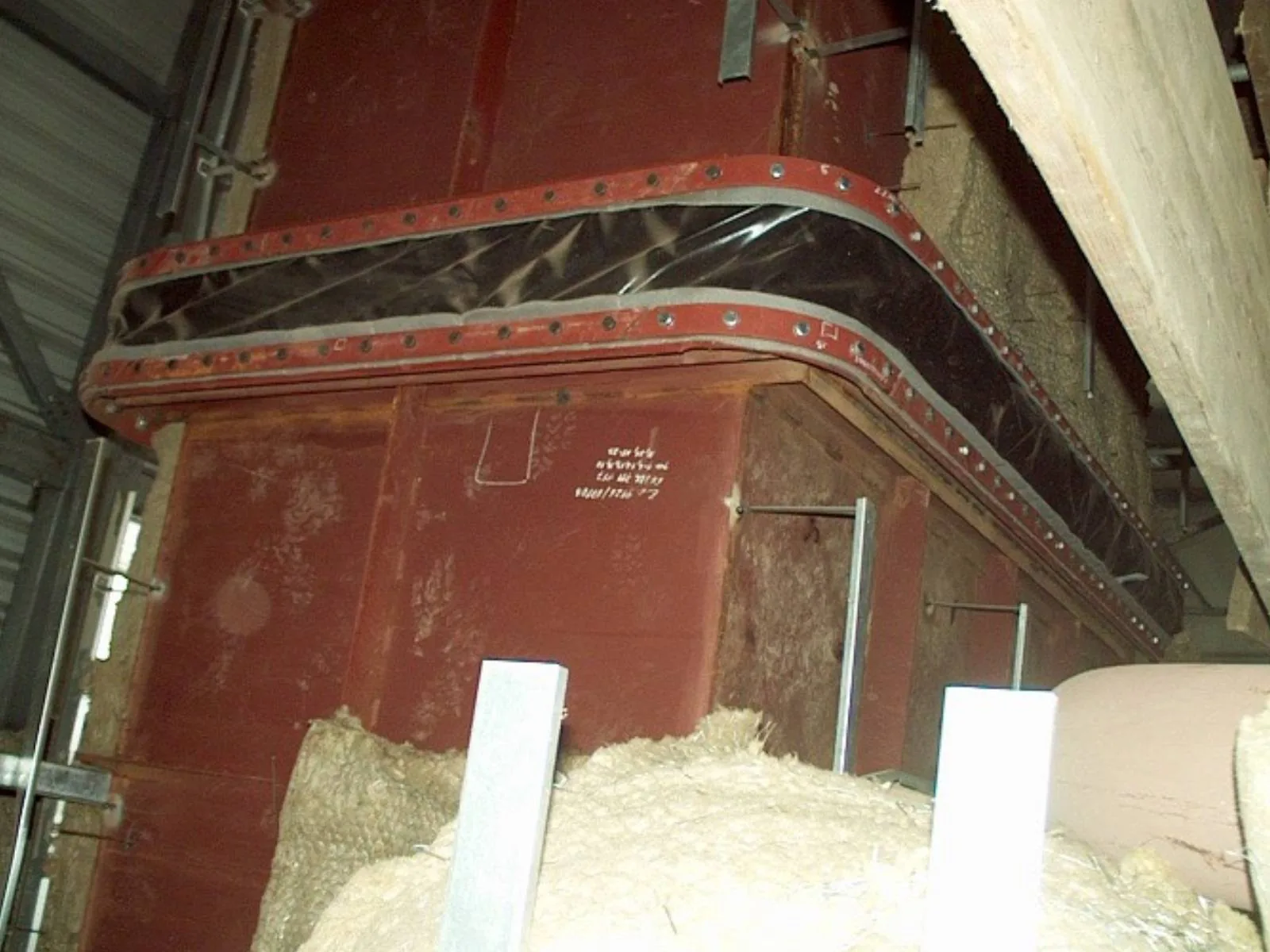
Hot gas ducts grow longer as they heat up and shorten as they cool, while connected equipment moves at different rates. A multi-layer fabric expansion joint absorbs this movement by flexing, without transferring loads to the duct or the equipment. Select a movement type and hover over a component to see its function.
Schematic cross-section for illustration; movements are exaggerated for clarity. Layer build-up and dimensions are defined per project according to the duct’s operating conditions.
Thermal expansion absorption, vibration isolation and acoustic break come together in one product, completed by external insulation integration and custom geometry options.
Safely absorbs ±50–200 mm of axial, lateral and angular movement on long stack and duct runs.
Cuts the transmission of fan- and blower-induced vibration into the structure; extends structural fatigue life.
Fiberglass, ceramic fiber or PTFE-based fabric options rated up to +900°C.
Breaking the sound transmission bridge reduces noise transmission along stack and duct lines.
A removable insulation jacket is integrated around the joint to prevent heat loss.
Made-to-measure production for rectangular, square, cylindrical or complex-shaped duct transitions.
Gas turbine exhaust duct joints, flue gas desulphurisation (FGD) ducts, post-FGD exhaust ducts, industrial fan and blower outlets, WHR exhaust inlet joints and cement plant rotary kiln stack ducts are the main areas. Duct geometry can be rectangular, square, cylindrical or oval; a dedicated template is prepared for each geometry. The face-to-face distance is determined by thermal expansion calculation.
Request a Site AuditTemperature is not the only criterion when selecting joint fabric; chemical environment, moisture, abrasion and vibration are evaluated together. OPTERM designs the facing and filler combination for the duct's actual operating conditions.
Silicone-coated fiberglass fabric is the standard choice in most plants: continuous service up to 250°C, no water or moisture uptake (absorption below 0.2%), UV and ozone resistant, and thanks to its flexible structure it does not crack under repeated removal and refitting. On flue gas lines with acid vapor or aggressive chemicals, Teflon (PTFE)-coated fiberglass is preferred; its non-stick surface and low friction coefficient (0.04–0.1) make it safe for petrochemical and chemical plants as well. At points with heavy mechanical abrasion and frequent contact, PU (polyurethane)-coated fiberglass is a more economical alternative with high abrasion resistance.
Get Material AdviceContinuous service up to 250°C, hydrophobic structure and UV resistance; the price/performance standard for general-purpose stack and duct lines.
Resistant to acid vapor and aggressive chemicals, non-stick surface; preferred in petrochemical and chemical plant ducts.
High abrasion resistance and economical cost; used at maintenance points with heavy mechanical contact.
At extreme temperatures above 800–1000°C (turbine exhaust, furnace surroundings), prevents the vitrification that standard fiberglass would suffer.
On inner or outer layers with heavy mechanical impact risk, protects the fabric against sharp surfaces and preserves the jacket's form.
Rock wool is the economical standard filler; needled fiberglass resists settling in vibrating environments; aerogel (Pyrogel) delivers 50 mm performance in 10 mm where space is tight.
In line with EJMA, ISO 15614 and EN 14706 references, the material and inner-liner combination is determined by duct geometry and gas composition.
Up to +900°C (material dependent)
±50 mm (standard) – ±200 mm (custom)
Fiberglass / ceramic fiber / PTFE / silicone-coated glass
Inner jacket filled with glass wool, mineral wool or ceramic wool
Carbon steel, stainless steel or special alloy
Rectangular, square, cylindrical, oval, custom
EJMA, ISO 15614, EN 14706
Metal bellows expansion joints suit high pressure but are costly and hard to maintain. Fabric expansion joints are a more economical, lightweight and high-temperature-resistant alternative for atmospheric or low-pressure flue gas and air ducts.
It is designed to absorb all movement modes: axial (compression/extension), lateral (shear) and angular (rotation); multi-directional movement capacity is tuned via geometry and fabric width.
Fiberglass-based expansion joints withstand up to +450°C; ceramic fiber (alumina-silicate) based ones up to +1000°C. Material selection is based on application temperature and the chemical environment.
If the flue gas contains acid gases such as SO₂ or HCl, PTFE-coated fiberglass or full PTFE fabric is selected; these materials resist acid condensation.
Movement capacity is determined by engineering calculation, based on the expansion and contraction difference between installation temperature and the maximum/minimum operating temperature.
In high-temperature or abrasive gas flow, an inner liner (an inner jacket filled with glass wool or ceramic wool) protects the fabric and reduces the temperature to the flange connection temperature. Generally recommended above +350°C.
Yes. In fan or blower applications, vibration damping capacity can be increased with a viscoelastic or multi-layer fabric configuration.
An annual visual inspection is sufficient. If tearing, delamination or hardening is observed in the fabric, only the fabric section can be replaced while the metal parts remain in place.
Duct size (width × height or diameter), face-to-face distance, movement type and amount, operating temperature and gas composition are sufficient.
Yes. On-site installation is provided on request.
Yes. A removable insulation jacket is integrated over the area between the joint flanges to prevent heat loss.
Fabric expansion joints are generally designed for 0–500 mbar (low-pressure) flue gas and air ducts. Higher pressures may require special design and materials.


 Türkçe