When valves in industrial plants are insulated with conventional methods, periodic maintenance becomes impossible. OPTERM's removable valve jackets offer a system that comes off in minutes during maintenance and goes back on afterwards. Every jacket is measured for its specific valve and sized with an ISO 12241 calculation.
When mineral wool + sheet-metal cladding is applied over a valve, the entire assembly has to be torn off and re-applied at the first maintenance. In other words, the insulation cost is repeated at every overhaul. OPTERM's removable valve jackets break this cycle: the jacket comes off in 3–5 minutes, maintenance is done, and the same jacket goes back on.
When you spread the maintenance cost of fixed insulation over the years, the investment in a removable jacket usually pays for itself before the first overhaul.
Request a Quote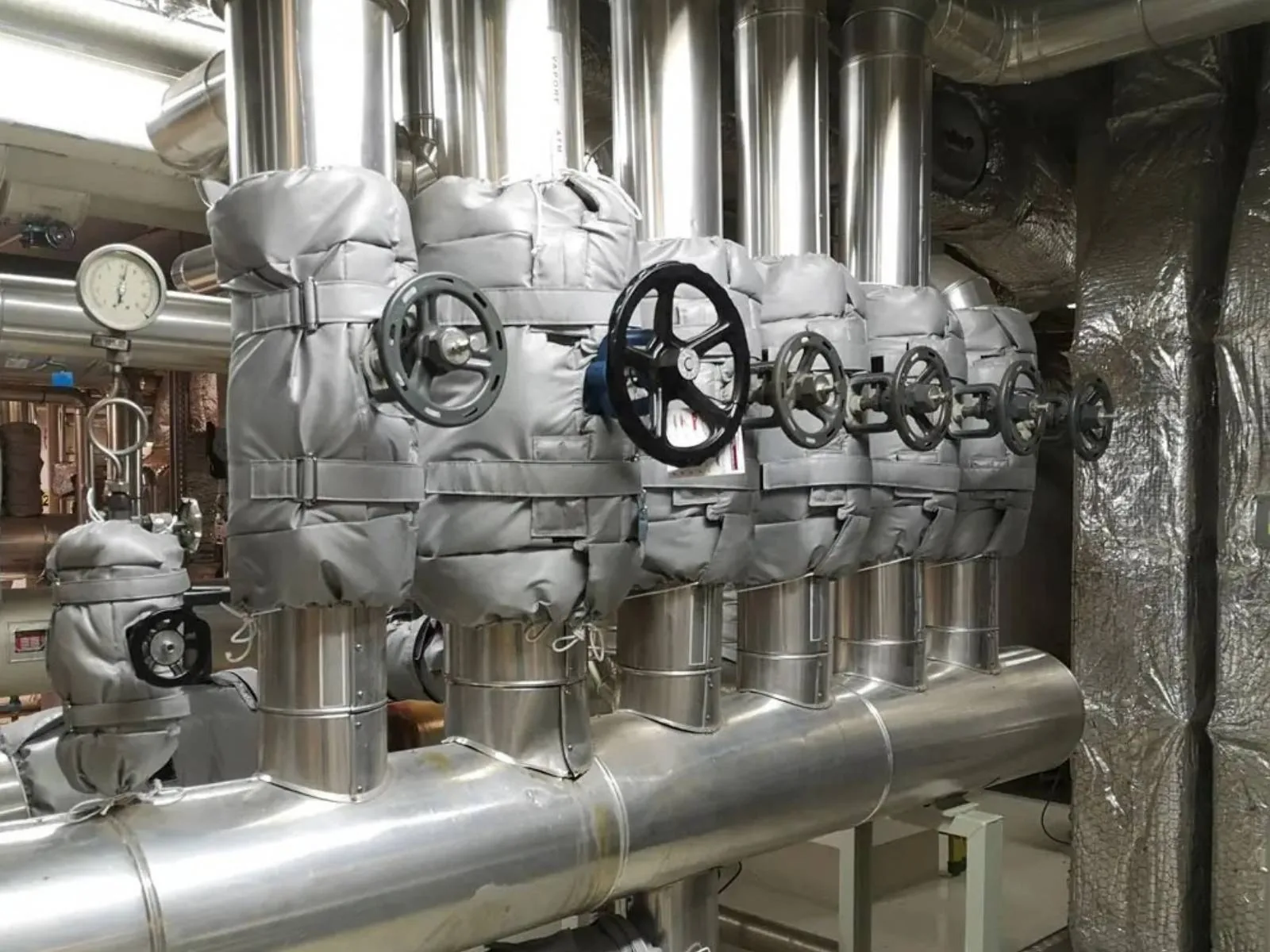
Valve bodies and flanges are the points on a line that lose the most heat and need the most frequent maintenance. Heat leaves these surfaces by conduction, convection and radiation; wind increases convection. A removable jacket limits this flow and, for maintenance, opens within minutes and is refitted in the same place. Select a view and a wind speed; the values change accordingly.
Schematic drawing for illustration. Still-air (0 m/s) values are taken from the example calculation on this page: DN80 flanged globe valve, 180 °C process temperature, 25 °C ambient, 7,200 h/yr. Windy cases are estimates derived from these values using general heat transfer correlations (equivalent cylinder approach, surface emissivity 0.9). A cooler jacket surface measured in wind does not mean the heat loss is lower.
Every valve geometry is different: globe, butterfly, segmented ball, control valve; each body has a different form. That's why we design each jacket from one-to-one measurements and manufacture it in our own workshop.
Every valve, flange and structure has a different geometry. Instead of a standard mold, each jacket is produced from one-to-one field measurements.
Time is critical during periodic maintenance. The jacket is removed and refitted within minutes using dedicated mechanical fasteners or a zipper.
Insulation thickness, surface temperature and energy savings are determined by the standard calculation method. Not a guess. A calculation.
After installation, a thermal-camera check is performed to confirm the surface temperature predicted at the design stage has been achieved.
We don't offer a single material option, and we don't work with a "one fabric fits all" mindset. We determine the most suitable combination together with you, based on service temperature, chemical environment, moisture conditions and budget.
The most common outer facing is silicone-coated fiberglass (continuous service up to 250°C, water absorption below 0.2%, UV and ozone resistant). On lines with acid vapor or aggressive chemicals, PTFE (Teflon)-coated fiberglass is preferred; where mechanical abrasion is heavy, PU-coated fiberglass is used. At extreme temperatures above 800°C we switch to silica or ceramic fiber fabrics, and to V4A stainless steel mesh where there is a risk of heavy mechanical impact.
Rock wool (standard, economical), needled fiberglass (won't settle in vibrating environments), aerogel/Pyrogel (high insulation with a thin profile in tight spaces) or ceramic wool (1000–1260°C); selected according to operating temperature and space constraints.
Silicone-coated fiberglass, PTFE (Teflon)-coated fiberglass, PU-coated fiberglass, aluminum-foil laminated fabric or V4A stainless steel mesh; selected according to moisture, steam, chemical environment and mechanical impact requirements.
On chiller and cooling lines, elastomeric rubber filler or PVC outer facing prevents condensation and the associated corrosion risk.
Stainless steel lacing hooks, zipper or hook-and-loop; determined by how often the jacket will be removed and how easy access needs to be.
Cement kiln lines, petrochemical process piping, power plant steam systems, food processing steam networks, automotive paint-shop ovens; just some of the environments where we apply valve jackets.
Request a Site Audit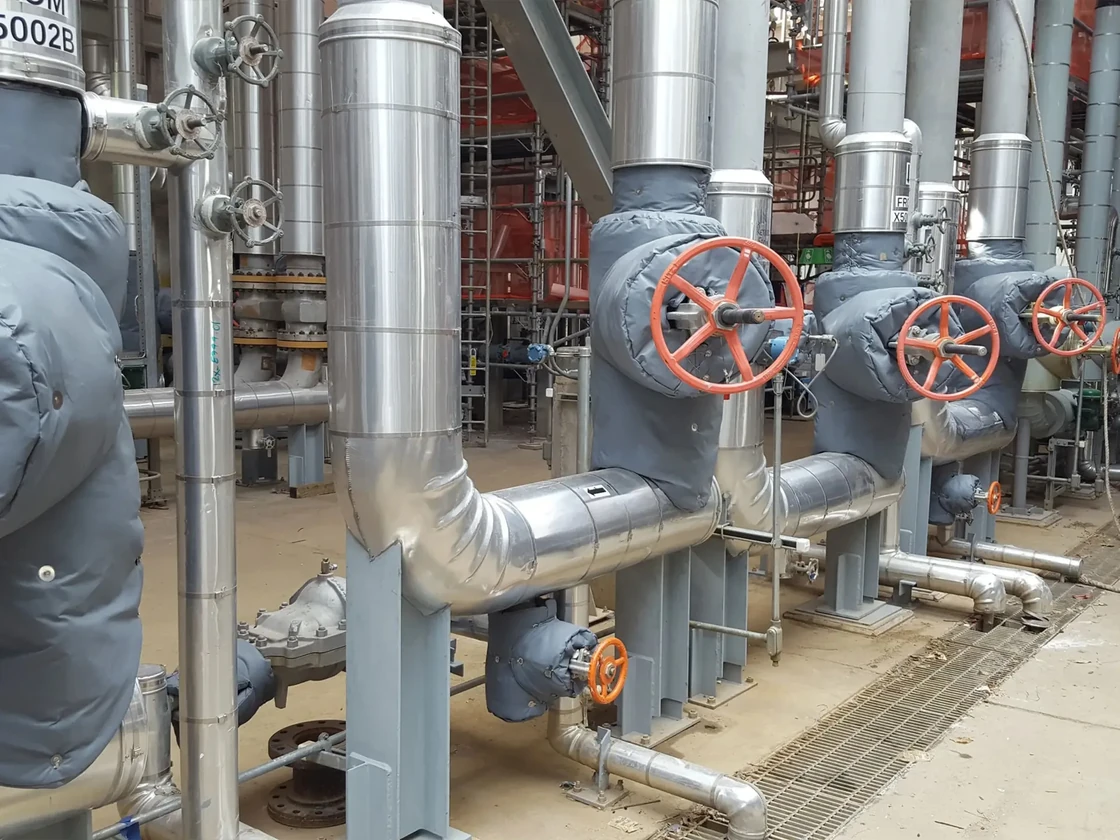
The figures below are taken from a real thermal audit report calculated on Optimizi.App using the ISO 12241 and EN 12828 methods. Scenario: an uninsulated DN80 globe valve operating at a 180°C process temperature, in a plant running 7,200 hours a year.
Assumptions: 25°C ambient temperature, 0 km/h wind, 90% boiler efficiency, natural gas at 8,250 kcal/m³ and ₺16.00/m³. Calculations are an engineering simulation based on steady-state conditions; results may vary under actual field conditions. Financial figures are calculated at the unit prices valid on the report date (July 2026).
Calculate your own plant's losses with Optimizi.App →It depends on surface temperature, valve diameter and annual operating hours, but in our field measurements the typical payback period is 6–12 months. On high-temperature lines running 24 hours a day it can drop to as little as 4 months. For an exact figure we schedule a site audit and calculate it on our Optimizi platform. See our step-by-step valve jacket payback article for the calculation method.
The generally accepted threshold is 60°C. Contact with a surface above this temperature for even a few seconds can cause serious burns. Many industrial valves operate above 150°C when uninsulated. A valve jacket typically brings the outer surface temperature below 40–50°C, eliminating this risk.
Sheet-metal cladding is a fixed insulation system applied to tank, pipe and equipment surfaces; it is economical on large surfaces and unchanging lines. A valve jacket, with its removable and reattachable design, is preferred at points that require frequent maintenance. The two methods are usually applied in the same plant to complement each other.
In a sample calculation performed on Optimizi.App according to ISO 12241, an uninsulated DN80 globe valve operating at a 180°C process temperature loses 7,503 kWh per year (7,200 operating hours/year, 25°C ambient). With a 90% boiler efficiency, that equals 869 m³ of natural gas and 1.68 tonnes of CO₂ per year. With a valve jacket installed, the loss drops to 589 kWh, a saving of 6,913 kWh per year on a single valve. When a plant has hundreds of valves, the difference becomes a significant line item on the annual energy bill. In our thermal-camera site audits we measure and report the loss of each individual valve.


 Türkçe