

 Türkçe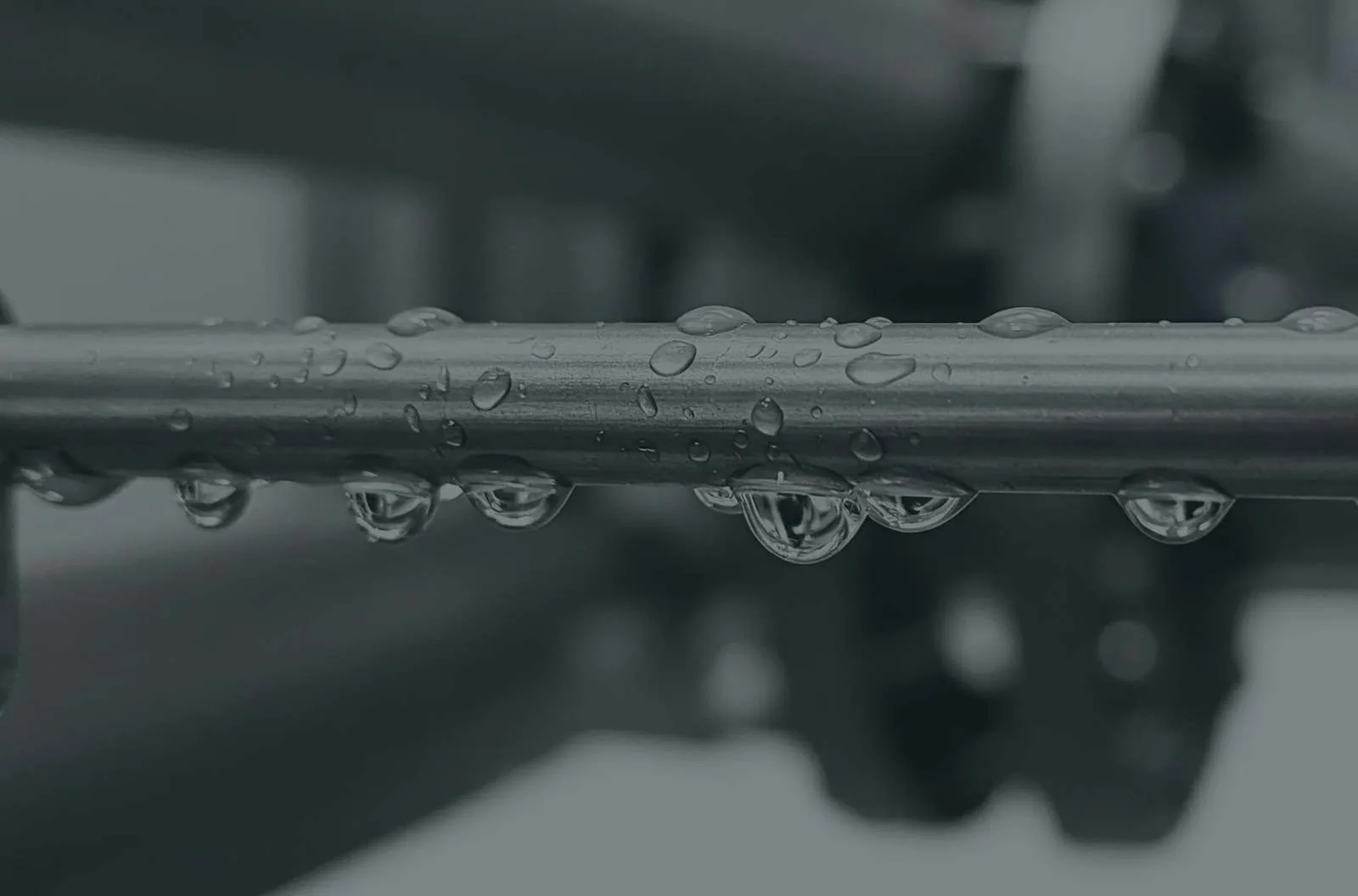
Why Does Condensation Form?
Air always carries a certain amount of moisture (water vapour). For this moisture to condense into liquid, it is enough for the surface temperature to fall below the dew point temperature of the ambient air. In industrial pipelines the dew point is generally in the 10-18°C range (depending on ambient conditions); every pipe or equipment surface below this value is a candidate for condensation.
Cold service lines (cooling water, ice storage, LPG gas lines, cold process fluids) operate below this temperature range by nature. These lines, when uninsulated or inadequately insulated, experience continuous moisture accumulation on their surfaces.
The Cascading Risks of Condensation
Corrosion and CUI
Moisture, oxygen and time accumulating on a pipe surface combine to initiate electrochemical corrosion. On cold service lines, corrosion advances more insidiously than on hot lines: the surface is wet but not visible; when insulation is covered with sheet-metal cladding, CUI (corrosion under insulation) continues silently for years. API RP 583 identifies cold service lines as a particularly high-risk zone for CUI.
Occupational Safety Risk
Condensate dripping from pipe or equipment surfaces leads to slip and fall accidents. On chemical process lines, condensate accumulating on equipment can amplify corrosive effects and create secondary safety risks.
Heat Gain and Process Control
While the cooling system expends energy keeping the fluid cold, continuous heat ingress occurs through the condensing surface. This consumes cooling capacity and makes process temperature control more difficult, causing the cooling system to overwork.
Practical rule: Surface temperature should be kept at least 2-3°C above the dew point of the surroundings. This creates a safe buffer zone against surface condensation.
Correct Insulation and Vapour Barrier
Preventing condensation on cold service lines has two pillars: adequate insulation thickness and a continuous vapour barrier.
Adequate Thickness
Per ISO 12241, the minimum thickness that keeps the surface temperature above the dew point under the determined dew point and ambient conditions is calculated. Applying "standard thickness" without this calculation can result in insufficient insulation.
Continuous Vapour Barrier
Water vapour can diffuse into insulation; a continuous vapour barrier is therefore essential not just on the outer surface but throughout the insulation system. Joints, flange transitions and equipment connection points must be carefully sealed.
Material Selection: What for Which Condition?
| Service Temperature | Recommended Material | Vapour Barrier |
|---|---|---|
| 0°C to +10°C | Glass wool or stone wool | Aluminium foil + sealing tape |
| -20°C to 0°C | Glass wool (high density) | Aluminium foil + HDPE vapour barrier |
| -50°C to -20°C | Polyurethane foam (PUR) | Integrated vapour barrier |
| -196°C and below (cryo) | Foam glass | Integrated, fully closed-cell structure |
Condensation Prevention in Removable Jackets
When removable jackets are used at flanges, valves and equipment connection points, the vapour-barrier property of the inner surface must be maintained. OPTERM produces jackets with a special vapour-barrier inner surface design for cold service applications. With this design, when a jacket is removed and refitted, vapour barrier integrity is also restored.
Summary
Surface condensation on cold service lines is a risk that is difficult to see but costly. Correct thickness based on ISO 12241, a complete vapour barrier and periodic thermographic inspection are the three key elements that make this risk manageable.
Assess your cold service lines
Request a thermal audit for condensation risk analysis and vapour barrier inspection.