Generator and engine exhaust lines, manifolds, silencers and aftertreatment equipment such as DOC and SCR units run at very high temperatures. OPTERM exhaust insulation jackets enclose these parts and are made to measure with vibration, thermal expansion and maintenance access in mind.
Bare exhaust lines radiate intense heat into the machine room, affect nearby cables and equipment and create a contact hazard. An insulation jacket reduces heat loss to the surroundings and helps the exhaust gas cool less along the line. DOC and SCR equipment is designed to operate within certain temperature ranges; insulation can help maintain the gas temperature reaching this equipment.
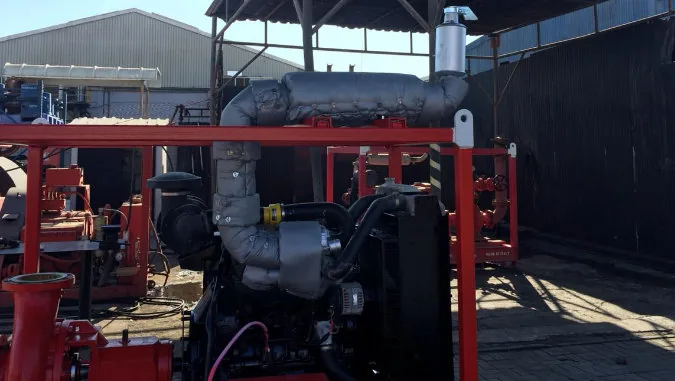
Exhaust lines lengthen as they heat up and vibrate with the engine. Bellows and expansion joints are left free to move, and jacket fastenings are detailed against loosening and wear.
Openable flaps or cut-outs are provided for temperature and NOx sensors, the urea (AdBlue) injector and sampling points.
The outer surface temperature is reduced to the target set for the project; areas staff could touch by accident are insulated first.
Exhaust jackets are built up layer by layer according to gas temperature, layout and mechanical exposure:
For manifold and turbocharger zones close to the engine, see our gas engine and biogas insulation jackets.
Insulation alone does not deliver an emission value. It can help maintain the gas temperature reaching aftertreatment equipment; the system's emission performance depends on the engine and aftertreatment supplier's design.
Silencer bodies can be insulated with jackets. On bellows and expansion joints, the jacket is designed flexible enough not to restrict movement, or as a separate section.
Yes. They are designed for outdoor use with a rain and UV-resistant outer face, overlaps facing the water run-off direction and drainage details.
Engine type, exhaust pipe diameters and lengths, silencer and aftertreatment equipment dimensions, gas temperature and photographs are enough for a preliminary assessment.


 Türkçe
 Deutsch
 Français
 Nederlands
 Svenska
 Norsk
 Dansk