Reactors run through heating and cooling cycles; the top head carries many nozzles, the agitator drive and sight glasses, and the bottom carries the outlet valve. OPTERM reactor insulation jackets wrap the shell, head, bottom and connections as separate modular parts, so only the relevant part is opened for cleaning, maintenance and inspection.
Cleaning, gasket changes, agitator maintenance and periodic inspection are frequent jobs on reactors. Fixed insulation is removed for this work and often left incomplete; exposed heads and nozzles lose heat and present a hot-surface hazard for operators. A modular jacket divides the reactor into shell, head, bottom and connection parts in maintenance order. Every part is numbered, and the same part is refitted when the work is done.
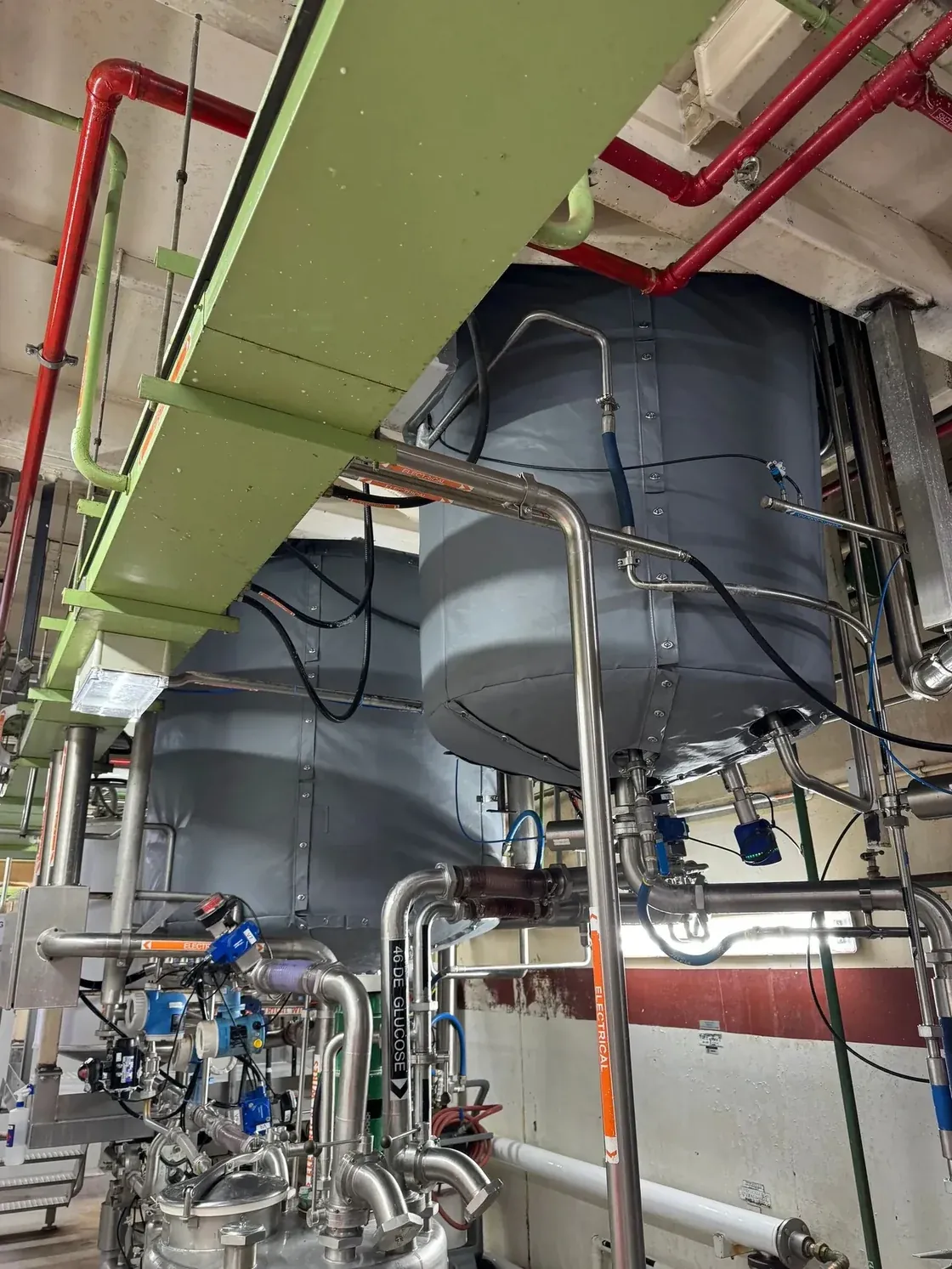
The head surface and nozzles are covered by the jacket; the motor, gearbox and coupling area are left open so the drive can cool.
Openable flaps are left at sight glasses and light ports, so the process can be watched without removing the jacket.
The bottom outlet valve and sampling points are covered with parts independent of the bottom jacket.
Reactors in chemical, paint, resin and pharmaceutical production with frequent charging, discharging and cleaning.
The outer wall of reactors with heating or cooling jackets, and the jacket inlet and outlet connections.
Reactors with half-pipe coils on the outer surface, and the coil manifolds.
The outer shell, flanged heads and nozzle connections of glass-lined reactors.
Stainless vessels in food, cosmetics and pharmaceutical plants that need a washable outer face.
Batch crystallisation and mixing processes where temperature control determines product quality.
The heating or cooling medium in the reactor jacket loses part of its energy through the outer surface to the surroundings. Insulation limits this loss.
The environment around the reactor determines the outer facing, stitching details and fastening method.
For lines connected to the reactor, see pipe and equipment insulation jackets; for valves, valve jackets; for storage tanks, tank insulation jackets.
Shell diameter and height, head and bottom type, nozzle list and positions, jacket inlets and outlets and the agitator drive are measured on site.
The jacket is divided into shell, head, bottom and nozzle parts in maintenance order; thickness is set using ISO 12241 calculation rules.
Parts are cut, sewn, numbered and labelled according to where they are fitted.
Jackets are fitted, fastenings are secured and outer surface temperatures are checked with a thermal camera.
Yes. The outer wall and the service connections of the heating or cooling jacket are measured and wrapped; inlet and outlet nozzles, drains and vents are left accessible.
The jacket covers the head surface and the nozzles; the motor, gearbox and coupling area are left open. The cooling needs of the drive and the manufacturer's instructions are taken into account in the design.
Yes. The jacket only wraps the outer shell and connections of the reactor; it does not change the reactor's operating instructions or its limits on temperature change.
Because less heat is lost from the outer surface, a larger share of the heating medium's energy goes into the product. The size of the effect is calculated from the reactor size, temperature and the condition of the existing insulation.
The thickness is chosen to keep the outer surface above the dew point, and a vapour barrier layer is applied with sealed joints. The same continuity is maintained at penetrations such as nozzles and flanges.
Reactor type, shell diameter and height, head and bottom type, nozzle list, heating and cooling media, operating temperature range, environment and photographs are enough for a preliminary assessment.


 Türkçe
 Deutsch
 Français
 Nederlands
 Svenska
 Norsk
 Dansk