Heat exchangers are opened regularly for cleaning, gasket replacement and leak checks. OPTERM heat exchanger insulation jackets wrap the shell, channel head, covers and nozzles as separate sections; only the section to be opened is removed during maintenance, and the same jacket is refitted afterwards.
Because of fouling, tube bundle cleaning, opening covers and renewing gaskets are frequent jobs on heat exchangers. Fixed insulation and metal cladding are torn off at every opening and often not rebuilt to the same standard, so covers and flanges end up bare. A removable jacket splits the exchanger into sections in maintenance order. Cover and channel head jackets are independent of the shell jacket, so the maintenance team opens only the part it needs.
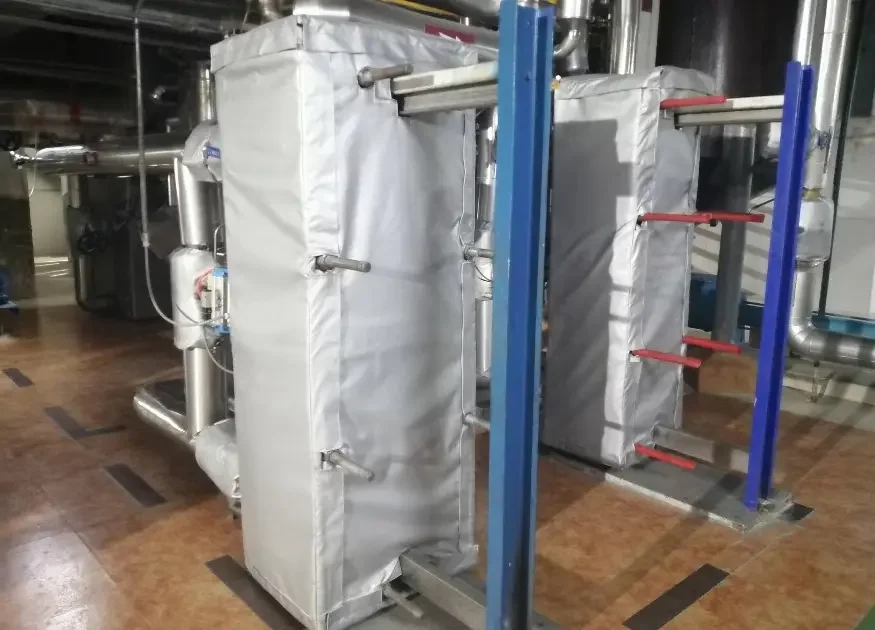
Channel heads and covers open fully for maintenance, so they get separate jackets while the shell jacket stays in place.
The plate pack and tightening bolts are enclosed by an enclosure-type jacket of side and top panels, lifted off before the plate pack is opened.
On cooling water and cold process lines, a vapour-barrier inner face and sealed overlaps prevent surface condensation.
Shell, channel head, covers, nozzles and flanged connections.
Plate pack, fixed and moving pressure plates, connection ports.
Circular body and front covers opened for maintenance.
Body, inlet and outlet ducts and inspection doors.
Shell diameter and length, nozzle positions, flange rating, bolt lengths and nameplate position are measured and photographed on site.
The jacket is split into cover, head, shell and nozzle parts in maintenance order; thickness is calculated from the operating temperature.
Parts are cut, sewn, numbered and labelled by installation position.
Jackets are fitted, fastenings secured and outer surface temperatures checked with a thermal camera.
Materials are selected together based on operating temperature, exposure to moisture, oil and chemicals, and maintenance frequency.
The size of the benefit is calculated from the exchanger's temperature, size and operating hours.
To see bare exchanger covers and their losses in your plant, we can start with a thermal audit. For connected lines see pipe and equipment insulation jackets, and for valves see valve jackets.
Yes. The plate pack is enclosed with side and top panels measured around the tightening bolts and connection ports. The panels are lifted off when the plate pack is opened and refitted afterwards.
The jacket does not change the exchanger's internal heat transfer; it only reduces heat lost from the outer surface to the surroundings, so the process fluid temperature is maintained with less energy.
Cover and channel head jackets are independent of the shell jacket. Fastenings are released and only the section to be opened is removed; because parts are numbered, the refitting order is clear.
Yes. It is designed for outdoor use with a rain and UV-resistant outer facing, overlaps facing the water run-off direction and drainage details.
Exchanger type, shell diameter and length, nozzle and flange list, operating temperature, indoor or outdoor location and photographs are enough for a preliminary quote. Final measurements are taken on site.


 Türkçe
 Deutsch
 Français
 Nederlands
 Svenska
 Norsk
 Dansk