On plastic extrusion lines, heat is lost continuously from the barrel, die head and adapter zones. OPTERM extruder insulation jackets enclose these surfaces; they are made to measure around heater bands, thermocouples and cable outlets, and are removed and refitted during maintenance.
An extruder barrel is held at process temperature by heater bands. From a bare barrel, heat passes to the surroundings by convection and radiation, so the heaters stay on longer to make up the loss. An insulation jacket around the barrel reduces this heat loss, lowers the outer surface temperature and can ease the load on the heaters. In our sample calculations, the jacket reduces heat loss from the barrel surface to the surroundings by approximately 85%. The drop in total heater energy use is smaller, because part of the energy is used to heat the melt. *The actual value depends on barrel temperature, duty cycle and the temperature control set-up.
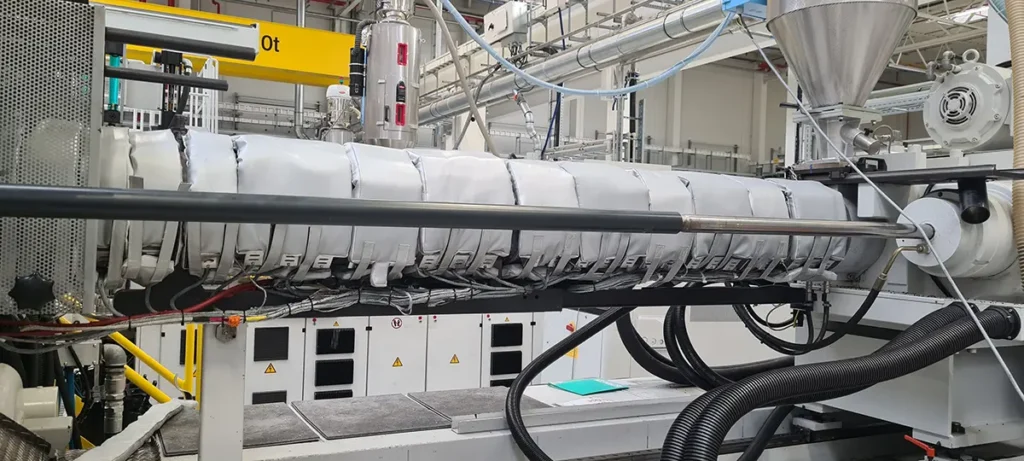
Fan-cooled barrel zones and the feed throat matter for process temperature control. The jacket is designed not to block cooling air, and these zones are left open where needed.
After insulation the barrel cools more slowly and the heaters cycle less often. Temperature controller settings should be checked at commissioning.
The outer surface temperature of the barrel drops, reducing the risk of contact with hot surfaces for operators and maintenance staff.
Heater zones of single and twin-screw extruders; each zone can have its own jacket.
Hot parts with complex geometry such as die heads, screen changers and adapters.
Heater-band zones of the injection unit barrel.
Hot zones of blow moulding machines, material dryers and hot-air lines.
Extruder jackets are designed zone by zone from on-site measurements of barrel diameter, heater zone lengths and connection points. A typical build-up:
Heater band type and the manufacturer's temperature limits are checked in the design. To see the savings on your own line, we recommend fitting one machine first and measuring heater energy consumption before and after.
For hot pipe connections and heat exchangers on your line, see pipe and equipment insulation jackets.
Two figures need to be separated. Heat loss from the barrel surface to the surroundings falls by approximately 85% with a jacket in our sample calculations. The drop in total heater energy use is smaller, because part of the energy goes into heating the melt and insulation does not change that part. Total savings depend on barrel temperature, operating hours, cooling needs and heater control; the most reliable method is to measure heater energy consumption on one machine before and after fitting the jacket.
Heater band type and the manufacturer's temperature limits are assessed. Jacket material and thickness are chosen to suit these limits, and zones that need cooling are left open.
Jackets are split by zone and secured with buckles or hook-and-loop. Only the relevant section is opened during a changeover, and the same jacket is refitted afterwards.
Machine make and model, barrel diameter and length, number of heater zones, die head and adapter dimensions, thermocouple and terminal box positions, and photographs are enough for a preliminary quote. Final measurements are taken on site after the order.


 Türkçe
 Deutsch
 Français
 Nederlands
 Svenska
 Norsk
 Dansk