On storage and process tanks, a large share of heat loss comes from manways, nozzles, valves and instrument connections whose insulation is broken at every maintenance. OPTERM insulates the tank shell with metal cladding or modular panels to suit the operating conditions, and covers the points that must be opened with removable jackets.
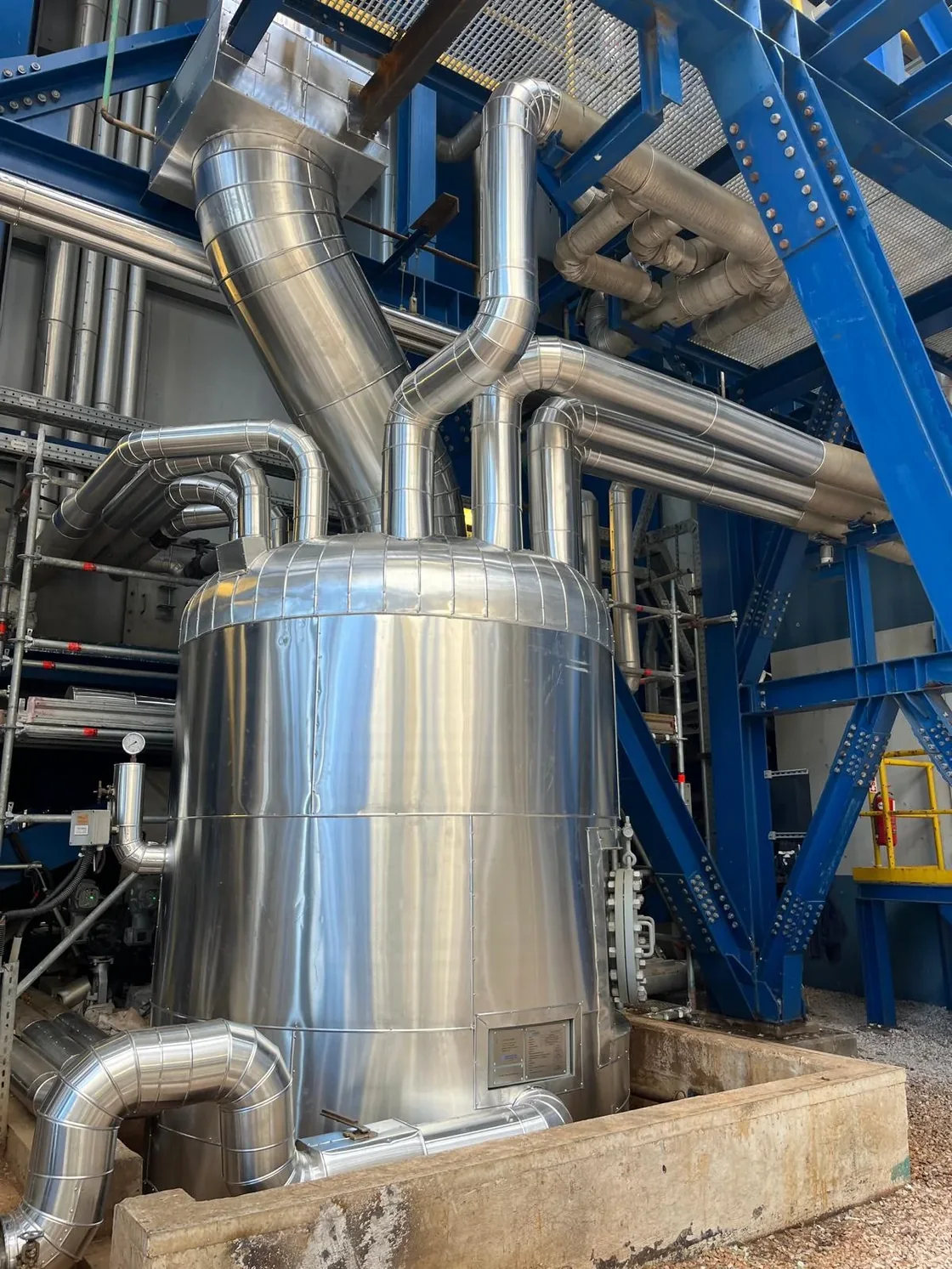
On the large shell of a storage tank, where no access is needed, metal-clad conventional insulation is a durable and economical solution. Manways, nozzles, valves, flanges and level gauges, however, are opened regularly for maintenance and inspection; fixed insulation is broken each time and often never rebuilt. A removable tank jacket covers these connections with separate parts. On small and medium process tanks that are cleaned or inspected often, the shell can also be wrapped with modular panels.
Manway covers and inspection openings are covered with jackets independent of the shell insulation; only this jacket is removed when the cover is opened.
Made-to-measure jackets and openable windows are prepared for fill and drain nozzles, valves and level, temperature and pressure instruments.
At roof connections, overlaps follow the direction of water run-off so that rainwater does not get into the insulation.
Tanks for products that must be kept warm to stay fluid, such as bitumen, fuel oil, heavy oils, molasses and resins.
Calorifiers, hot water storage and buffer tanks that store thermal energy.
Agitated tanks that are cleaned frequently and need regular access to their connections.
Tanks in areas that need a washable outer face and a finish that resists chemical splashes.
Chilled product, glycol and cooling water tanks where surface condensation and icing must be prevented.
Horizontal tanks whose dished ends, saddles and connections must each be insulated separately.
Losses come not only from the shell but also from the roof, the bottom and the connections. A sound insulation plan treats them together.
To see where losses are concentrated on your existing tanks, we can start with a thermal audit.
The life of tank insulation depends largely on whether water gets into it.
Water entering through cladding joints, damaged areas or connections left open is held in the insulation material. Prolonged contact between wet insulation and the steel surface is a main cause of corrosion under insulation (CUI), especially on carbon steel tanks, and the damage progresses without being visible from outside.
Tank diameter and height, roof type, nozzle list, platforms and ladders, operating temperature and ambient conditions are recorded on site.
Cladding or modular panels are chosen for the shell, and thickness is set using ISO 12241 calculation rules.
Connection jackets are sewn to measure and numbered; cladding parts are prepared to the tank's geometry.
Insulation is installed, overlap and sealing details are checked, and outer surface temperatures are verified with a thermal camera.
The layer build-up is set by the operating temperature, the tank's environment and how often it is maintained.
For large shells, see metal-clad conventional insulation; for reactors and agitated vessels, reactor insulation jackets; for drums and IBCs, IBC and drum heating jackets.
It can, but on large tank shells where no access is needed, metal-clad conventional insulation is usually more economical. Jackets stand out where access is needed: manways, nozzles, valves, instruments and inspection areas. Most projects combine the two methods.
Thickness is set using ISO 12241 calculation rules, taking into account the tank's operating temperature, ambient temperature and wind, and the target surface temperature or permitted heat loss. On cold service tanks the deciding criterion is usually preventing condensation.
Less of the energy supplied by the heating coil or heater is lost to the surroundings, and the product temperature is easier to maintain. The benefit is calculated from the tank size, product temperature, ambient conditions and the condition of the existing insulation.
The thickness is chosen so that the outer surface stays above the ambient dew point, and a vapour barrier layer is applied with sealed joints to stop moisture reaching the insulation.
In most cases, yes. Hot work, scaffolding and safety measures are planned according to the plant's permit and safety procedures. Bottom insulation, however, can usually only be done when the tank or its foundation is built.
Tank type, diameter and height, roof type, nozzle list, product and operating temperature, indoor or outdoor location and photographs are enough for a preliminary assessment. Final dimensions are taken on site.


 Türkçe
 Deutsch
 Français
 Nederlands
 Svenska
 Norsk
 Dansk