Removable insulation jackets custom-made for flanges, elbows, tees and reducers, boiler doors, pumps and access openings. Every jacket is measured for its specific equipment and sized with an ISO 12241 calculation. For valve jackets and all jacket types, see removable insulation jackets; for fixed pipe and tank insulation, see metal-clad insulation.
Flange, tee, elbow and reducer zones are hard to cover with conventional sheet-metal cladding; when maintenance is needed, the whole system has to be dismantled. OPTERM's removable pipe jackets are shaped for each specific geometry and come off easily during maintenance.
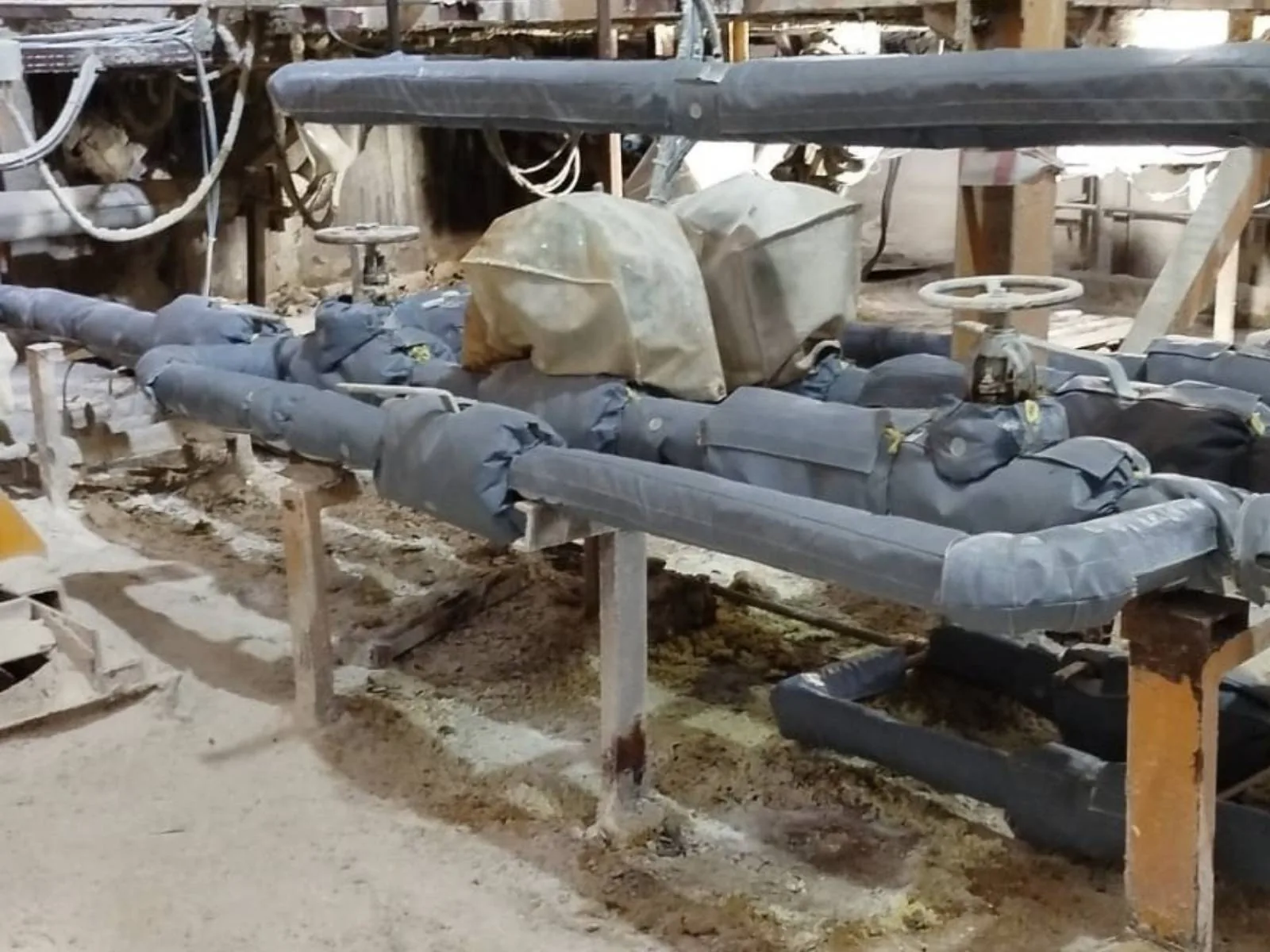
A dedicated pattern is prepared for every point, including flange, tee and elbow zones.
The maintenance team reaches the pipe connection quickly by removing the jacket; the cladding is not destroyed.
Insulation thickness calculated for service temperature and ambient conditions prevents unnecessary material use.
When the front and rear doors of steam boilers and thermal oil boilers are insulated with fixed sheet cladding, any burner maintenance, gasket replacement, or periodic internal inspection means destroying the whole insulation and rebuilding it from scratch each time. OPTERM's boiler door jackets are custom-sewn to the door's full geometry, including the burner opening and inspection port; the jacket is removed before maintenance and refitted afterward.
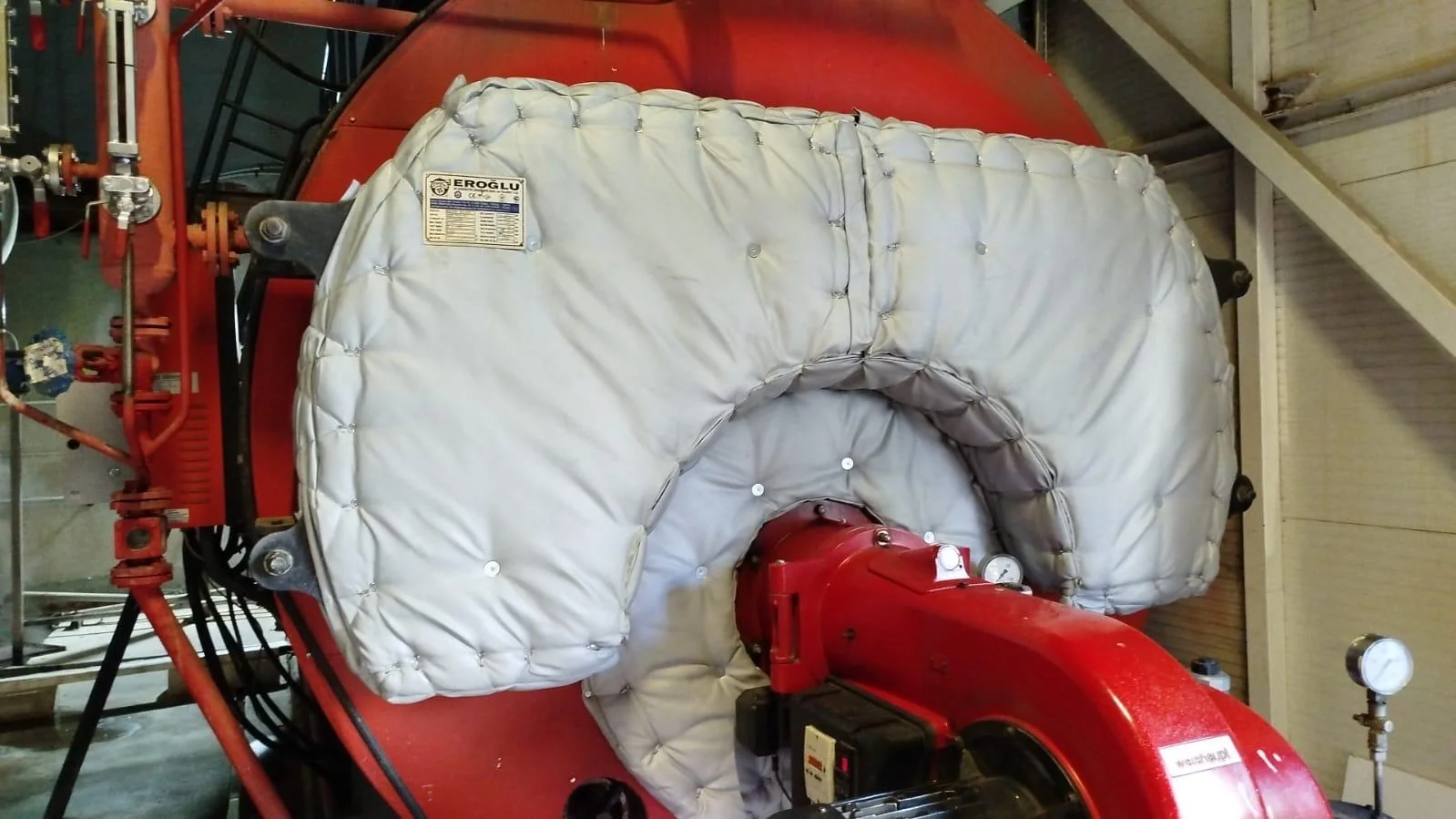
Separate cutout allowances are left for every connection, gauge and inspection point on the door; installation never blocks access to any equipment.
Before internal inspection, gasket replacement or burner overhaul, the jacket is removed within minutes, eliminating the need to cut and rebuild fixed cladding.
Pump bodies, strainers, filter housings and access covers are the points on a pipeline that are opened most often and left bare most often. A removable jacket is shaped to their geometry; it is taken off for strainer cleaning, seal checks or cover opening and refitted afterwards.
The strainer cover is designed as a separate part, so only the cover jacket is opened for cleaning.
Gland, mechanical seal and coupling areas are left open; motor cooling and access are not obstructed.
Easy-opening, reusable cover jackets for checking covers, bolts and gaskets.
Jackets removed section by section for shell-and-tube, plate and spiral exchanger shells, heads and covers.
Details →Jackets for the manways, nozzles, valves and instrument connections of storage and process tanks.
Details →Modular jackets for reactor shells, heads and bottoms, manways and nozzles.
Details →Jackets around the body, bonnet and flanges, with openings for the stem, handwheel and actuator.
Details →Flange, tee, elbow and reducer zones of pipelines (DN15 to DN1200), steam and thermal oil boiler doors, pump bodies, strainers, filter housings and access covers. Heat exchangers and tanks and reactors have their own product pages. Every jacket is measured for its specific equipment and sized with an ISO 12241 calculation.
The maintenance team reaches the connection point quickly by removing the jacket; there is no need to destroy the cladding as with fixed insulation. Since the body, cover and nozzle sections are designed as independent panels, removing one does not affect the others, and the same jacket is refitted after maintenance.
The operating temperature range depends on the chosen inner fabric, filler and outer facing; different materials are used from cold service up to high-temperature applications. On hot lines, the reduction in heat loss is calculated from the operating temperature, equipment size and insulation thickness; on cold lines it keeps the surface temperature above the dew point, preventing condensation and corrosion risk.
It is calculated according to the ISO 12241 standard based on service temperature, ambient conditions and the targeted energy savings, and a calculation report is provided to the customer. This prevents unnecessary material use and reaches the target surface temperature by calculation.
Yes. Steam boiler and thermal oil boiler front/rear doors are custom-measured and sewn to the door's full geometry, including the burner opening and inspection port. The jacket is removed before maintenance and refitted afterward once the work is complete, without needing to destroy the insulation as with fixed sheet cladding.


 Türkçe
 Deutsch
 Français
 Nederlands
 Svenska
 Norsk
 Dansk