Turbine casings, inlet and outlet flanges and hot connection zones run at high temperature and must be opened during overhauls. OPTERM turbine insulation jackets split the complex geometry into sections in removal order; each section is refitted by its number.
Fixed insulation on a turbine casing is torn off and rebuilt at every overhaul, costing both time and material. In a sectional jacket system, the casing, flanges, inlet and exhaust connections are split into separate jackets. Jackets are numbered and labelled in installation order, so the maintenance team opens only the section it needs to reach.
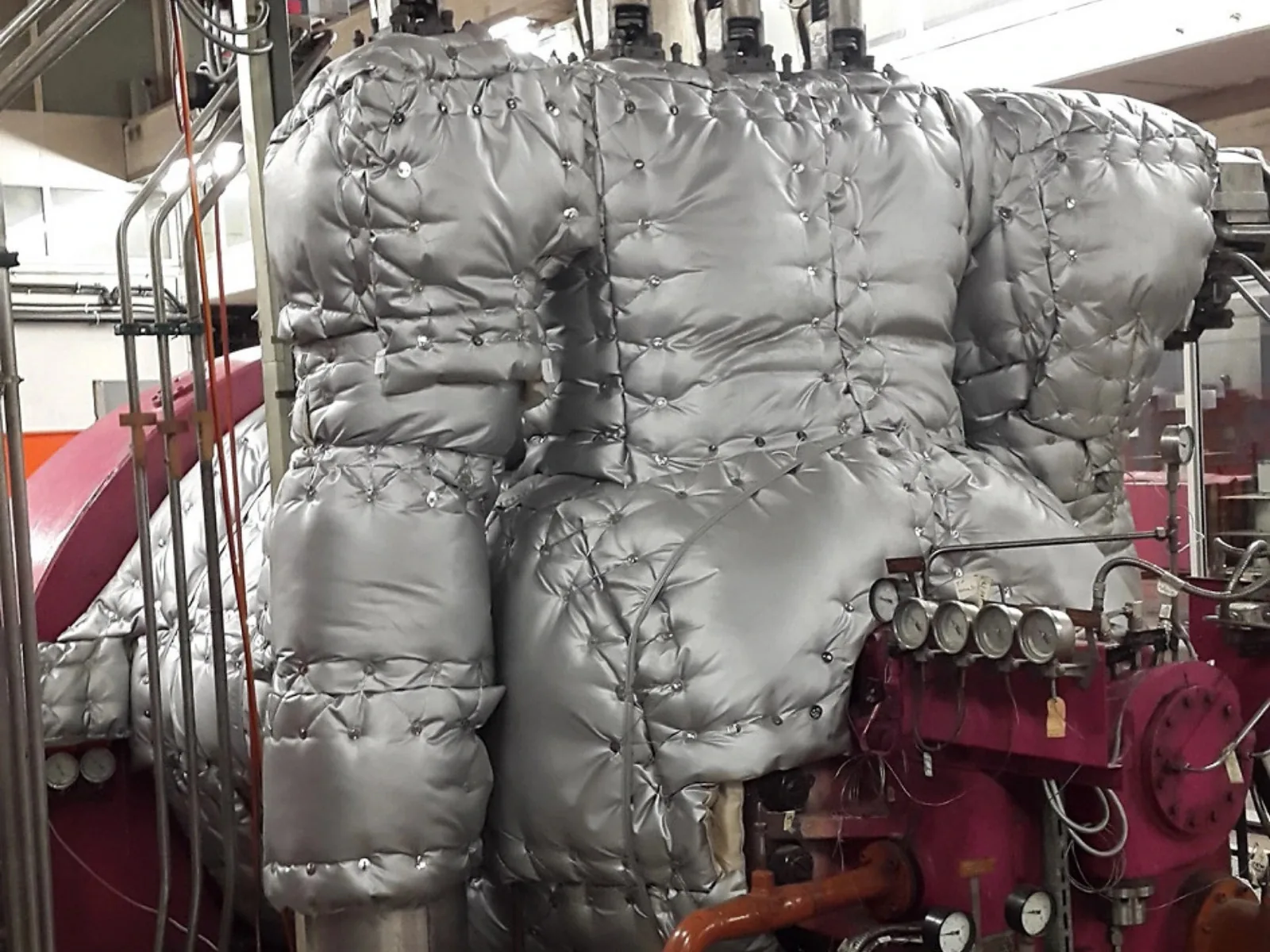
Conical casings, flange bolts, lifting points and instrument connections are recorded during measurement, and jacket cut-outs are made to match.
The outer surface temperature target is set according to personnel access and machine hall conditions; insulation thickness is calculated to meet it.
Expansion during heat-up and cool-down is accommodated by jacket overlaps and fastening details, and jackets are secured so they do not open as the casing moves.
The turbine casing is modelled digitally and divided into jackets according to the removal sequence. Rotate the model, separate or assemble the jackets, and hover over a jacket to see its details.
Select a jacket from the list or the model. The selected jacket is highlighted and the others fade.
This is a sample model for illustration. Each project is modelled separately based on the measurements of the turbine on site.
Materials for turbine jackets are chosen according to surface temperature, allowable thickness and exposure to oil or steam:
In areas with a risk of oil leaks, oil absorbed into the filler can become a fire hazard. Sealed outer facings and suitable overlap details are preferred there.
For valves and hot pipe sections connected to the turbine, see valve jackets and pipe and equipment insulation jackets; for gas turbine exhaust lines, see exhaust insulation jackets.
Typical areas are steam turbine casings, inlet valves and flanges, gas turbine exhaust sections and connections, and hot pipe sections connected to the turbine.
The temperature limit depends on the selected fabric and filler. The surface temperature of each zone is measured or taken from operating data, and materials are chosen to suit it.
Because the jackets are sectional and numbered, removal and refitting are more orderly and faster than breaking out and rebuilding fixed insulation. The time depends on turbine size and the number of jackets.
Turbine type, general arrangement drawings if available, operating temperatures, photos of the existing insulation and the planned overhaul date are enough for a preliminary assessment. Final measurements are taken on site during a planned shutdown.


 Türkçe
 Deutsch
 Français
 Nederlands
 Svenska
 Norsk
 Dansk